
Aluminium and Fire in Construction
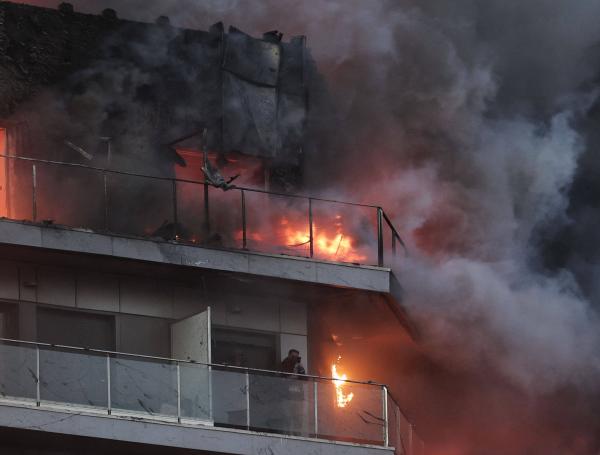
ALUMINIUM AND FIRE IN CONSTRUCTION
What should we know?
When we talk about construction materials, the same question always arises: How do they behave in the event of fire?
Aluminium itself is a non-combustible material; it is Class A1, the same as steel, but that does not mean that an aluminium structure can withstand a fire indefinitely without protection. Let’s look at it step by step.
What does it mean that aluminium is Class A1?
In the European Union and the United Kingdom, the Euroclass system is used to measure the reaction of materials to fire.
- A1 is the highest category: it means “non-combustible”.
- A Class A1 material does not spread flames, does not produce significant smoke, and does not contribute to the fire.
Typical examples of Class A1 materials: steel, aluminium, concrete, glass, or stone.
In other words, if we use aluminium without organic coatings (such as paint or plastics), we can be sure that the material will not be part of the problem in the event of fire.
But beware: reaction to fire ≠ fire resistance
This is where confusion often arises:
- Reaction to fire measures whether a material burns or not.
- Fire resistance measures how long a structural element can withstand the fire without losing its function.
Example:
A steel or aluminium beam is Class A1 (non-combustible), but as temperature increases it loses mechanical strength.
- Steel starts to lose it at around 500–600 °C.
- Aluminium: from about 250–300 °C.
That is why, in buildings such as hospitals or schools, the regulations usually require that the main structures are compartmented and achieve 30, 60, 90, or 120 minutes of fire resistance, depending on the type and height of the building.
This is achieved through additional protection: intumescent paints, coatings, insulation panels, etc.
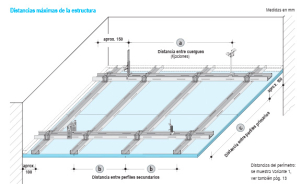
Fire-resistant false ceiling panels for insulation 30’–120’
What about aluminium in construction?
European legislation (Decision 2005/403/EC) allows natural or anodised aluminium to be automatically classified as A1, without the need for further testing.
However:
- If the aluminium or other materials have organic coatings (lacquered, polymer, plastic films), they may drop to A2 or even B, meaning that they do contribute to fire to some extent.
- In extreme cases, such as composite panels with plastic cores (ACP/ACM), much lower classifications can occur — banned in some countries for high-rise façades (the most tragic example being Grenfell, in London).
The case of the EXTEND-SYSTEM telescopic beams
At EXTEND-SYSTEM, we work with telescopic beams of extruded aluminium, alloy 6063-T6, without coating, certified under DIT 270R/09.
These beams are Class A1, that is, non-combustible.
They have been installed in many public and private buildings, for example, at CIES School in Mataró, proving their effectiveness as a reinforcement solution.
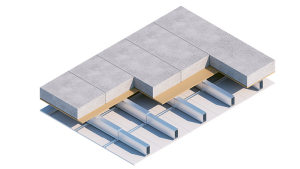
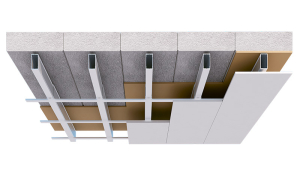
Protection of an EXTEND beam with fire-resistant panels
Like any metallic material, aluminium requires additional protection if R60, R90 or R120 fire resistance is required in hospitals or high-rise buildings.
The important point is that the system integrates easily into tested solutions that comply with these requirements.
So, is aluminium a good option?
The answer is clear: yes.
Aluminium is an excellent alternative for reinforcing ceilings affected by pathologies such as RAAC (Reinforced Autoclaved Aerated Concrete) or concrete carbonation, because:
- It is non-combustible (A1), therefore it does not favour fire spread.
- It is lightweight and strong, making installation easier without overloading the existing structure.
- It enables quick and efficient solutions in sensitive buildings such as hospitals, schools, or public and private facilities.
The key is to design the complete system with appropriate protection to ensure that, in addition to not burning, the structure maintains its strength for the time required by regulations.
Conclusion
Fire is one of the major challenges in construction.
A1 aluminium provides a safe base because it does not burn or spread fire. But as a structural element—like steel, concrete, or timber—it needs to be complemented with protection to guarantee the resistance required for each building.
EXAMPLE: EXTEND-SYSTEM TELESCOPIC BEAMS WITH DIT 270R/09 CERTIFICATE
The EXTEND-SYSTEM telescopic beams, certified under DIT 270R/09, have been installed in many buildings such as CIES School in Mataró.
According to certificate DIT 270R/09, the beams are made of extruded aluminium, alloy 6063-T6.
- These beams are Class A1, meaning non-combustible, according to Decision 2005/403/EC.
- In terms of UK Building Regulations, aluminium has a “Class O” classification, which also indicates low fire contribution, according to current requirements (britmet.co.uk + NBS Source + BIMobject®).
However, there is an important nuance:
The EXTEND-SYSTEM telescopic beam system by itself is:
- Basically a functional replacement or structural reinforcement made of aluminium.
- As an A1 material, it is non-combustible, but it has no inherent fire resistance, just like steel, which loses mechanical strength at high temperatures.
- Therefore, if an element must be R120, the beams must be protected (intumescent paint, encasement, insulation, etc.) or form part of a protected system.
Regulations in the United Kingdom
In UK regulations, the Class 0 classification was historically used, but after Grenfell, it was replaced by the Euroclass system.
In hospitals and healthcare buildings:
- Approved Document B and HTM 05-02 (Healthcare Premises) establish that the main structure must normally achieve R120 in multi-storey or large buildings.
- Structural roofs supporting occupied areas must also comply with R120 (with some exceptions).
This means that A1 (non-combustible) does not by itself guarantee fire resistance: the performance of the entire tested system must be verified.
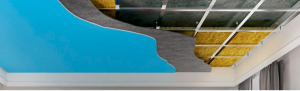
Multilayer false ceiling
NOTE: Behaviour of oak timber in fire.
Timber behaves differently from steel or aluminium because it does not lose strength suddenly—it chars on the surface, meaning it loses section:
- From about 200 °C, pyrolysis begins: it loses water, degrades chemically, and flammable gases appear.
- Between 250–300 °C, ignition starts if enough oxygen is present.
- At around 300–400 °C, a charred layer forms that protects the interior. The inner section remains much cooler thanks to this insulating layer.
- The charring rate of oak is relatively low (approx. 0.5 mm/min in standard tests).
- Therefore, timber fire resistance is achieved by increasing section size or through specific treatments.
IMPORTANT:
All structures must, in order to protect people, have fire stability and resistance.
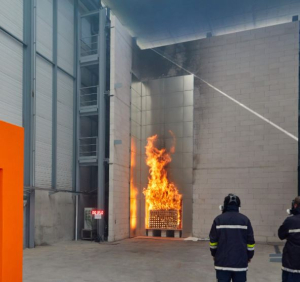
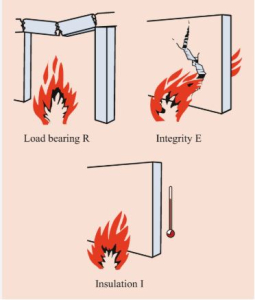
Materials are tested in laboratories to verify fire resistance
EXTEND-SYSTEM: A FAST, EFFICIENT, AND SAFE SOLUTION
In this context, EXTEND-SYSTEM offers a high-performance technical alternative: a structural reinforcement system based on telescopic aluminium beams, specially designed to intervene in floors and roofs deteriorated by carbonation or RAAC.
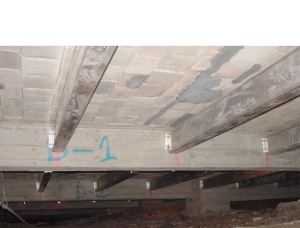
Extend-system beams in ceiling reinforcement
Main advantages of the EXTEND-SYSTEM:
- Fast and dry installation, with no need for concreting or welding.
- Dimensional adaptability, thanks to its telescopic design allowing on-site adjustment to the exact length required.
- Lightweight, facilitating transport and assembly without heavy auxiliary means.
- Durability and corrosion resistance, thanks to the use of high-strength aluminium profiles.
- Reversible, demountable, and reusable solution, aligned with the principles of the circular economy.
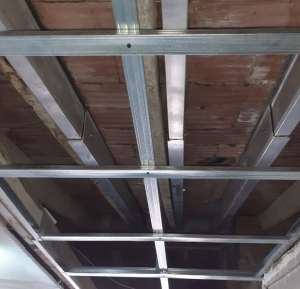
Lightweight structure supporting fire-resistant panels on slabs reinforced with EXTEND-SYSTEM beams
EXTEND-SYSTEM, ALUMINIUM AND SUSTAINABILITY
Modern construction must not only meet safety criteria but also those of sustainability. Aluminium, the main material of the EXTEND-SYSTEM beams, provides clear advantages in this respect: its lightness reduces energy consumption in transport and assembly, while its long service life minimises the need for replacements or intensive maintenance.
Moreover, aluminium is 100% infinitely recyclable without losing its properties, making it a natural ally of the circular economy.
Incorporating systems such as EXTEND-SYSTEM therefore means reinforcing structures with an efficient, safe, and environmentally friendly solution, aligned with the sustainability standards demanded today by administrations and responsible projects.
A modern, safe solution, fully aligned with the requirements of sustainability, fire protection, and structural reinforcement in buildings in use.
Conclusion
Fire is one of the greatest challenges in construction.
A1 aluminium provides a safe base because it does not burn or spread fire. But, like any structural material, it needs protection to achieve the resistance required by regulations.
EXTEND-SYSTEM telescopic beams combine the best of both worlds:
A lightweight, practical, and efficient solution for reinforcing structures affected by RAAC or other pathologies.
More information
For more details, you can visit the official EXTEND-SYSTEM website, where you will find assembly examples and applications in various structural pathologies.
Further information on EXTEND beams can be found on the website
An example of the installation of EXTEND beams can be seen here
EXTENSION OF EXTEND BEAM SOLUTIONS
Other entries that may interest you:
What is carbonation of concrete?


Leave a Reply
Want to join the discussion?Feel free to contribute!