
Xylophagous Organisms and their impact on Wooden Structures

Xylophagous Organisms and their impact on Wooden Structures
Xylophagous organisms are living beings that feed on wood (from the Greek xylon – wood and phagein – to eat). This term is generally associated with insects such as termites and woodworm, although other animals like beavers or pandas also have a wood-based diet, a behavior known as xylophagy.
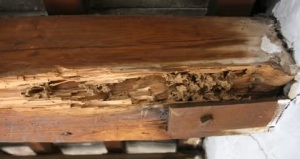
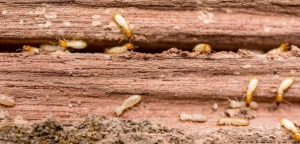
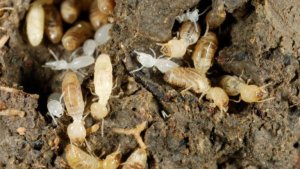
Beam affected by termites
DOMESTIC TERMITES
Termites (Isoptera) are social insects, similar to ants, that live in darkness and feed on the cellulose present in wood. They often go unnoticed because they build hidden nests where the queen resides, remaining immobile and being fed by worker termites. The colony is divided into different castes: workers, soldiers, and reproductives.
These insects excavate tunnels in the wood to move and feed. At certain stages of their life cycle, some termites develop wings and emerge to form new colonies. Their activity affects various wooden elements in buildings, such as beams (if present), parquet flooring, furniture, door frames, and even books.
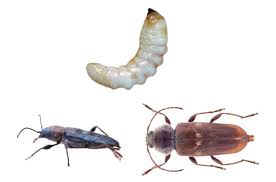

Woodworm life stages: larva, beetle – Beam affected by woodworm
WOODWORM
Woodworm belongs to the beetle (Coleoptera) group. Its biological cycle includes a larval stage during which it bores tunnels inside the wood while feeding on it. Its presence can be detected by small holes on the surface and by the accumulation of sawdust or wood dust. In some cases, a faint sound produced by the larvae gnawing the wood can also be heard.
IMPACT OF XYLOPHAGOUS ORGANISMS ON BUILDINGS
Although xylophagous organisms play a crucial ecological role in the decomposition of dead wood, their presence in buildings poses a serious problem. Many structures have been built using wooden elements, particularly beams and floor structures. Over time, the activity of termites and woodworm can weaken these elements, compromising their load-bearing capacity and endangering the safety of the building.
The main causes of deterioration include poor maintenance, unfavorable humidity conditions, and the lack of preventive treatments. In extreme cases, it may be necessary to reinforce or replace the affected beams, sometimes even requiring the complete renovation of floor structures.
Since these pests can spread rapidly, treatment should be carried out urgently by specialized companies using specific methods for each type of insect and level of infestation. However, eliminating the infestation alone does not resolve the structural issues caused by wood degradation.
The removal of xylophagous pests is necessary but not sufficient, as it does not solve the problems caused by wood deterioration, particularly the weakening of wooden beams and their load-bearing capacity.
Beam degradation results from both the natural aging process of the wood and the presence of xylophagous organisms that seek shelter and food in the building’s beams. These beams become porous and structurally weak as their useful cross-section decreases, allowing moisture to penetrate.
Improving the quality of life for building users requires enhanced health and safety conditions, ensuring the security of the structures. To achieve this, a qualified technician must inspect the building to assess its condition and determine the necessary improvements, whether through partial or complete rehabilitation. The required actions should be analyzed based on priority and an approximate cost assessment.
EXTEND SYSTEM

Functional replacement, installing EXTEND-SYSTEM beams between the affected ones
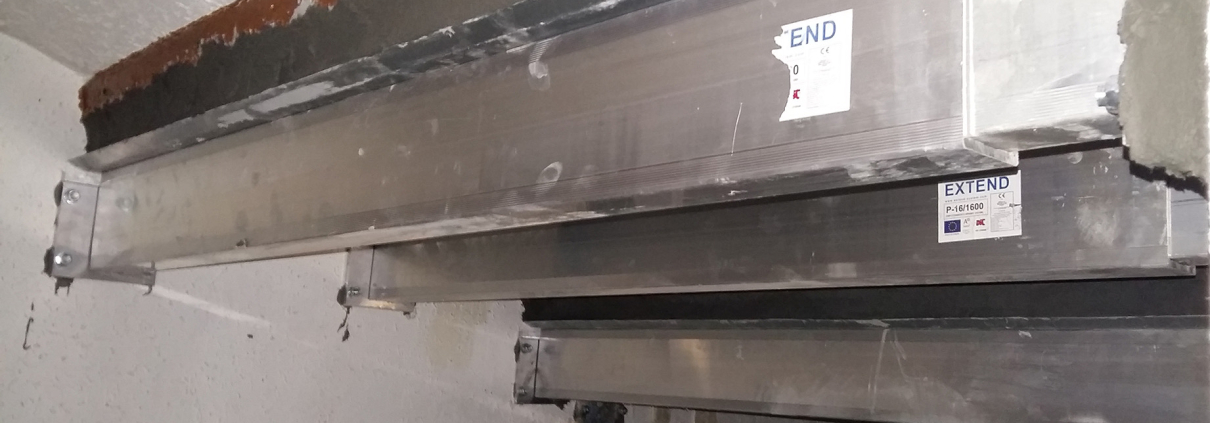
Functional replacement, installing EXTEND-SYSTEM beams beneath the affected ones
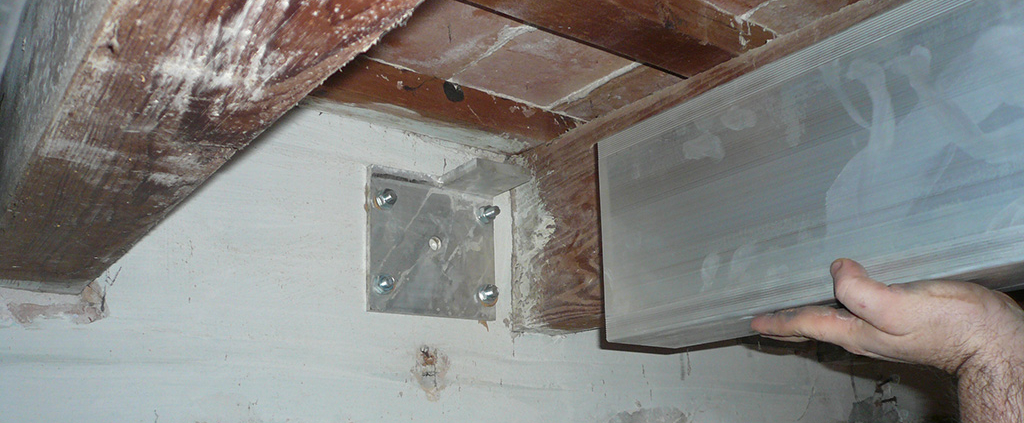
Easy installation of extend-system beams supported on the bracket
SOLUTION FOR DETERIORATED BEAMS: EXTEND-SYSTEM
Once the pest has been eradicated, it is essential to restore the structural capacity of the affected beams. One of the most effective solutions for this is the EXTEND-SYSTEM beams, a system developed for the functional or physical replacement of deteriorated beams.
In 1992, architect Josep M. Vulart designed and patented this innovative system to reinforce wooden beams, as well as concrete structures affected by pathologies such as aluminosis, carbonation, and RAAC in the UK. Its implementation provides a quick, safe, and durable solution to structural degradation problems.
CHARACTERISTICS OF EXTEND-SYSTEM BEAMS
EXTEND-SYSTEM beams are composed of two or three rectangular-section aluminum tubular profiles, assembled telescopically to adapt to different lengths and facilitate transportation. This technology allows for easy installation without the need for screws or welding, ensuring quick and effective reinforcement.
Custom Design
Once the pathology is detected, the design and calculation of the necessary beams are carried out. At this point, the technician must customize and prescribe the most appropriate solution, prioritizing guarantee, ease of assembly, and economy.
Main Advantages:
- Exact adjustment without the need for additional fixings.
- Lightness, facilitating handling and avoiding overloading the building’s structure; EXTEND-SYSTEM beams weigh one-third of equivalent steel beams.
- Strength and durability, thanks to their fabrication in special aluminum alloy.
- Quick assembly, reducing intervention times in rehabilitation.
- Quality certification, with Technical Suitability Document from the Eduardo Torroja Institute since 1993 and CE mark since 2014.
On the website https://www.extend-system.com/en/ you can find more information about the characteristics of EXTEND beams.
At the link https://www.extend-system.com/en/assembly/ , you can see an example of the assembly of EXTEND beams.
Click the link to request a quote: https://www.extend-system.com/en/budget/


